Industry Dynamics
High barriers to entry
There are high capital requirements of $500m - $1bn for building a plant, and long lead times to add capacity.
Need access to cheap energy, as the purification process requires a lot of energy. Polysilicon processing is estimated to be 85% of the energy input into the whole module. For instance, Wacker Chemie has own hydro power and co-generation unit for its plant.
There are synergies of operating a fully integrated chemical plant with cost advantage over pure-play silicon producers.
In addition, trade barriers in the form of import duties on poly-silicon from U.S. into China have hampered expansion of silicon production in the United States.
|
|
Upstream: Non-differentiated supply prices set by market
The input material is metallurgical grade silicon with around 98.5% purity. This is a commodity that is traded on international exchanges such as the London Metals Exchange. Costs in 2009 are around $1,700 per ton, down from $2,500 per ton in 2008.
Suppliers of metallurgical grade silicon tend not to forward integrate into polysilicon production.
|
| |
 |
 |
Conclusion
With wafer- and cell manufacturers forward-integrating into polysilicon, new entrants, especially in the solar-grade segment and aggressive plans for capacity build-up, the once sheltered oligopoly is seriously challenged. Competition is increasingly based on capacity. These drivers eat into once exceptional margins. However, after the massive drop in polysilicon prices, the cost advantage of solar-grade silicon is fading, as demonstrated by the bankruptcy of Timminco in 2012 or the de-listing of Arise. |
 |
Competition based on capacity, dominated by only few companies
Competitors
The industry is dominated by a handful of companies. Interestingly, the those companies have changed over the years, but not so much the number.
Product Differentiation The purer the silicon the less material is required per kWp. Wacker claims that each gram per Watt in energy yield improvement supports a polysilicon price premium of around 50€/kg. However, solar applications do not require the same purity levels as electronic chips. Therefore, a number of companies such as Timminco specialise in solar-grade silicon, which can be produced more cheaply.
Cost Structure and Margins
Cost for the raw silicon is only 4% of the overall production cost. This is a very high fixed cost business. Thanks to the oligopoly and the notorious supply shortage average gross margins are high.
|
 |
| |
 |
 |
Low threat of substitution
The only alternative to polysilicon comes in the form of thin-film technologies. However, due to lower module efficiencies,thin-film might not always be a suitable alternative, especially when space is at a premium.
Switching costs, however, are very high, as manufacturing processes for crystalline and thin-film modules are very different.
In the electronics market, there is no substitute for high purity silicon.
|
|
Downstream: Governed by Oligopoly
90% of the market is governed by fixed supply agreements lasting 6 - 10 years. To secure those contracts, buyers were asked for pre-payments. Less well capitalised companies paid by selling equity. For instance, DC Chemicals bought 15% of Evergreen Solar stock in exchange for 1GW of polysilicon. MEMC received a warrant worth of a 4.9% share in SunTech.
|
|
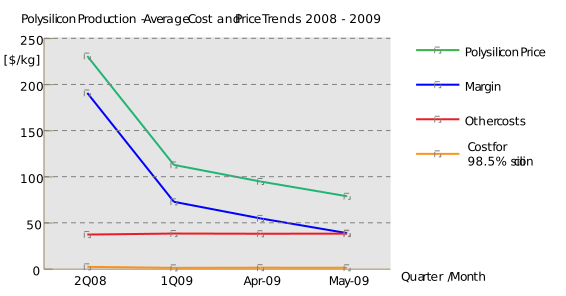 Polysilicon Average Cost Trends
As the cost of raw silicon makes up only 4% of the total silicon production costs, the price drop in raw silicon did not change the cost structure at all.
However, due to the drop in demand, the average margins have come under pressure, increasing the pressure on cost. Companies with access of cheap energy will therefore have an absolute cost advantage.
In comparison, medium-term estimates for solar-grade producer Timminco are $20/kg for production cost at a gross margin of 25%, reflecting the discounted price for solar-grade over high-purity polysilicon.
|

Polysilicon Spot Price
Following a collapse in demand for solar electricity at the same time as new polysilicon capacity has come online, the spot price for polysilicon has collapsed from a $450 per kg peak in August 2008 to below $100 in June 2009. However, contract prices have always been well below the spot market. Average polysilicon prices at the end of 2009 were $60 per kg.
Even though demand has resumed after 2009 the price of polysilicon has decreased even further to $10 per 2020 due to huge increase in production capacity.
|


